Working at Height: Anchor Points and Fall Clearance Calculation
A worker is wearing a harness, it is properly clipped on, the lanyard is sound — and he still reaches the ground before the system stops him. This is one of the most common patterns in work-at-height incidents: the equipment was present and undamaged, but the clearance below was never enough for the system to do its job. Wearing a harness is not the protection. The protection is the whole arrangement: the anchor, the lanyard, the energy absorber, the clearance, and the rescue plan.
What follows is general principle. Binding figures and specifications are set by local regulations and by the manufacturer's instructions, and a competent person must sign off on any arrangement on a real site.
Restraint beats arrest, every time
Fall restraint means the lanyard is short enough that you physically cannot reach the edge or opening. You never fall. There are no impact forces, no clearance calculation, no suspension risk. Always prefer it.
Fall arrest means you do fall and the system then stops you. That involves energy, forces on the body, distance consumed before stopping, the chance of swinging into an obstruction, and an urgent need for rescue. Use it only when preventing access to the edge is not possible.
Think in order: eliminate the work at height, then guardrails and fixed platforms, then restraint, then arrest. PPE is the last line of defence, not the first.
Full body harness, not the old body belt
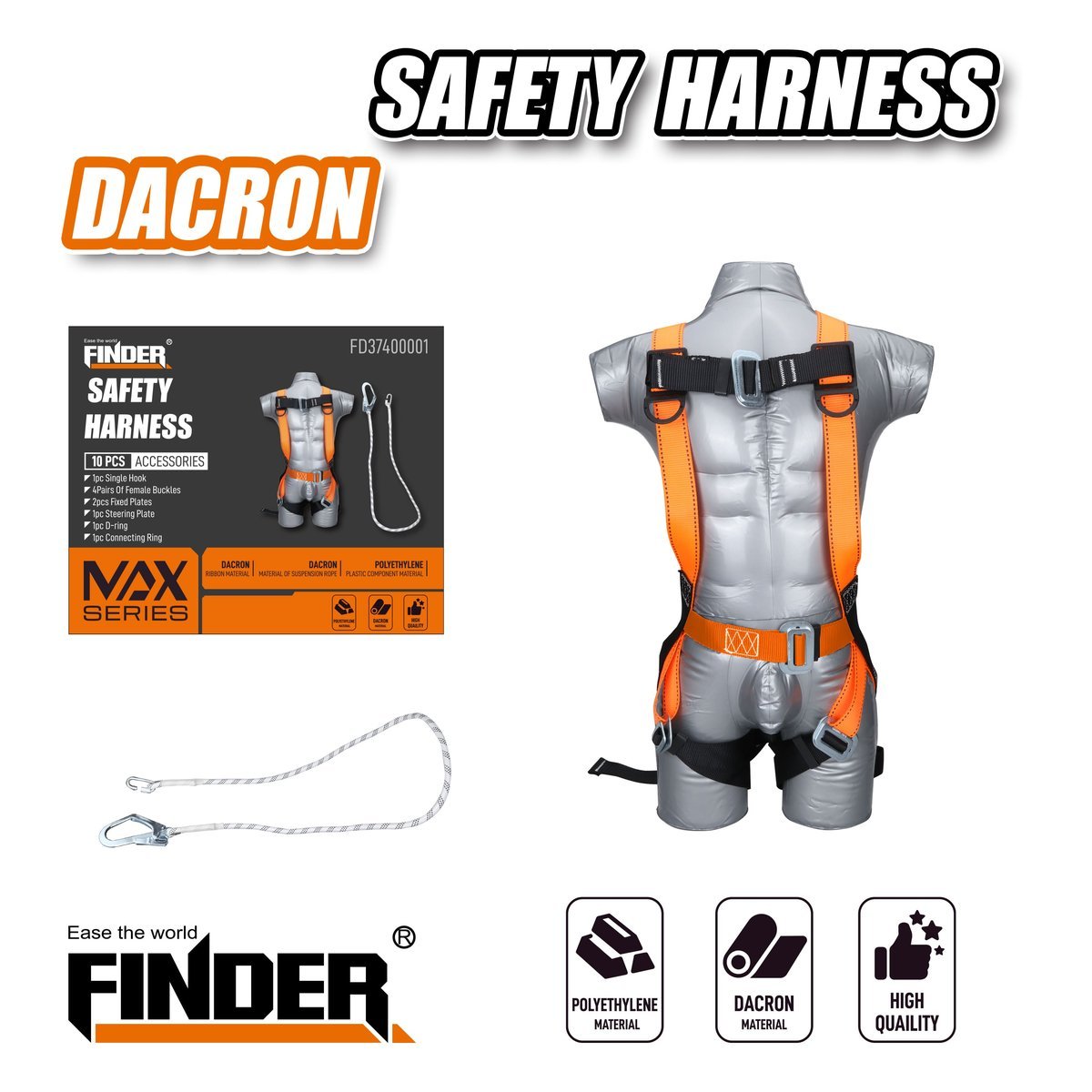
A waist belt concentrates the entire arresting force on a narrow band across the abdomen and lower back, transmitting it to internal organs and the spine. Serious internal injury is possible even if the person survives the fall, and the body can slip or invert. A full body harness spreads the load across thighs, chest and shoulders and holds the body roughly upright after arrest. The rear dorsal D-ring between the shoulder blades is the usual arrest attachment; front and side rings have specific purposes such as work positioning and are not interchangeable substitutes.
The calculation that gets missed: total fall clearance
The system does not stop you instantly — it needs distance. If the available space below you is less than the distance the system needs, you hit the ground or an obstruction before arrest completes and the harness is worthless.
Total required clearance below the anchor is made up of:
- Lanyard length — the free fall before the system engages.
- Shock absorber deployment — the absorber works by controlled tearing or stretching, so it physically lengthens during arrest.
- User height below the attachment point — dorsal ring to feet.
- Safety margin — extra space between the feet and the nearest surface once all movement stops.
Anchor position matters too: an anchor at foot level rather than overhead greatly increases free fall distance, the forces generated, and the chance of striking the edge.
Do not use remembered generic figures. Actual deployment distances and margins are product-specific and are stated by the manufacturer; requirements vary by jurisdiction. Calculate for each location, from the product documentation, under competent supervision. If the clearance is not there, fall arrest is the wrong answer and you need restraint, a physical barrier, or a shorter-arrest system.
Anchor points are not whatever you can reach
- Overhead where possible — reduces free fall and the risk of a pendulum swing into a wall or column.
- Designed and assessed for the purpose — never a drain pipe, conduit, light handrail, duct, or an unqualified scaffold component. These were never designed for arrest forces.
- Specified by a competent person — anchor capacity is not a guess; it depends on the actual structure and the applicable rules.
- Watch sharp edges — a line running over a sharp steel edge can be cut during a fall. Use edge protection or an edge-rated system.
Why a shock absorber is not optional
Arresting a fall on a non-stretch lanyard with no energy absorber dissipates the energy in a very short time, and the resulting peak force on the body exceeds what a person can safely tolerate even in a full harness. The absorber extends the stopping time and brings peak force down to a survivable level. Every arrest system must include energy absorption, whether as an in-line absorber or built into a self-retracting lifeline. A plain lanyard used for arrest is a serious error.
Suspension trauma and the rescue plan
Once arrested, the person is hanging. Leg straps compress blood vessels, blood pools in the legs, and condition can deteriorate within a short period even without injury from the fall itself. Rescue therefore has to be fast, and you cannot rely on waiting a long time for an outside party.
- Write the rescue plan before anyone goes up, not after an incident.
- Name who performs it, with what equipment, from where, and how long it takes.
- Do not leave someone working at height alone without communication and monitoring.
- Rehearse the plan practically.
- Treat a recovered person as a medical emergency even if they appear fine.
Inspection and removal from service
| Component | Look for |
|---|---|
| Webbing | Cuts, abrasion, broken fibres, burns, heavy UV fading, stiffness |
| Stitching | Pulled, cut or missing stitches |
| D-rings | Distortion, cracks, deep corrosion, sharp edges |
| Hooks and connectors | Gate and auto-lock operating smoothly and closing fully |
| Shock absorber | Intact cover, no sign of partial deployment |
| Self-retracting lifeline | Smooth pay-out and retraction, locks on a sharp pull |
| Label | Present, legible, inspection record current |
Absolute rule: any equipment that has arrested a real fall is removed from service immediately and never reused, however sound it looks. Internal damage to fibres and to the absorber is not visible. Tag it clearly as out of service pending a competent person's decision, with disposal as the default. The same applies to equipment of unknown history or exposed to heat or chemicals.
Summary
Work at height is not about putting on a harness. Eliminate the work, then use guardrails and platforms, then restraint, and only then arrest. If you reach arrest, calculate total clearance carefully: lanyard, absorber deployment, body length, margin. Anchor overhead at a point assessed by a competent person. Never run an arrest system without energy absorption. Have a rescue plan before the climb. Inspect before every use, and retire anything that has arrested a fall. For all binding figures and specifications, follow local regulations, manufacturer instructions, and competent advice.