Pipe Joint Types: Threaded, Compression, Solvent Weld and Fusion
Ask an experienced plumber where the leaks they are called out to fix originate, and the answer is almost never the middle of a pipe. It is the joint: an overtightened thread that cracked, a reused compression olive, a solvent weld pressurised before it cured, or copper bolted straight onto galvanised steel. Understanding how each joint type actually works, not just what it looks like, is what separates a system that lasts from one that needs constant attention.
Threaded joints
Not all threads are the same. A taper thread narrows along its length, so tightening increases interference and the seal comes from the thread flanks engaging each other. A parallel thread has constant diameter and does not seal on the threads at all — it seals on a washer or a flat face. Put a parallel thread into a taper socket, or the reverse, and you get a weak mechanical engagement and a leak no amount of extra tightening will stop.
Sealant and wrap direction
PTFE tape must be wrapped so that tightening pulls it tighter, not off. Hold the pipe with the threaded end pointing toward you and wrap clockwise. Wrapped the wrong way, the first turn of assembly scrapes the tape off and pushes it ahead of the fitting instead of compressing it into the threads.
Wrap count is judgement: three to four wraps on small diameters, up to six or seven on larger sizes or worn threads. One wrap is not enough. Ten wraps stop the thread reaching its proper depth and put excessive hoop stress on the fitting. Thread paste is a good alternative or supplement, particularly on old or irregular threads, because it fills surface imperfections better than tape.
Overtightening cracks fittings. Cast iron and brass fittings split under excess torque, and the crack often does not show immediately — it opens weeks later under pressure cycling. Tighten until resistance is clear, then add one to two turns at most. If it still leaks, strip it and re-seal rather than tighten further.
Compression fittings
A compression fitting has a body, an olive (ferrule) and a nut. Tightening the nut drives the olive into a tapered seat, where it deforms plastically and bites a continuous circumferential seal onto the pipe surface.
That plastic deformation is both the strength and the limitation: once tightened, the olive has taken a final shape matched to that pipe in that position. Reusing it on another pipe, or after disassembly at a slightly different angle, is a known weak point. If you take a compression joint apart, fit a new olive.
Common leak causes: a cut that is not square or has been crushed; burrs left on the inside or outside edge; pipe not inserted fully so the olive compresses over unsupported wall; overtightening, which cuts into soft pipe and creates a tear line; and side loading from a pipe that pulls the fitting off axis, slowly opening the seal.
Solvent weld for PVC
Solvent cement is not glue. It dissolves the surface layer of both pipe and fitting so the material intermingles, and as the solvent evaporates the two become one piece. Success therefore depends entirely on surface preparation: square cut, deburred edges, surfaces clean of dust, grease and moisture, then primer to open the surface and remove the gloss. Apply cement to both parts, push fully home with a quarter turn to distribute it, and hold a few seconds because the joint tends to push back before it grips.
The critical wait is before pressurising. Initial set is quick; full strength takes considerably longer, increasing with diameter and working pressure and decreasing with ambient temperature. Follow the cure table printed on the cement container. Pressurising an uncured joint is one of the most common failure causes — it can look sound and then blow later under a surge.
Heat fusion for PPR
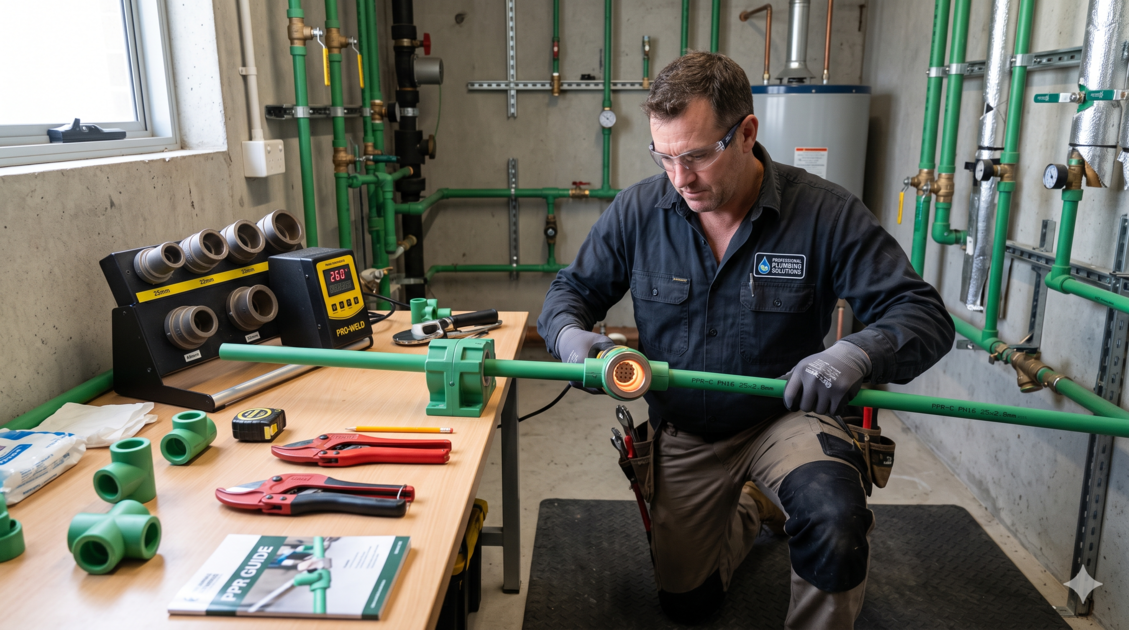
Polypropylene is not solvent welded; it is fused. The welder heats pipe and fitting to a set temperature, the surface softens, the pipe is inserted and the melt merges and cools as one continuous body.
| Variable | Common error | Result |
|---|---|---|
| Heating time | Too short | Shallow fusion that fails under pressure |
| Heating time | Too long | Excess melt pushed inward, restricting or blocking the bore |
| Insertion depth | Short of the mark | Insufficient fusion area |
| Cooling | Joint moved before set | Invisible internal cracking |
Heating time increases with diameter — small sizes need a few seconds, large sizes several times that. Do not work from memory: every manufacturer publishes a table for its own pipe. Mark insertion depth before heating and push straight to the mark without twisting (unlike solvent weld, rotation spoils fusion). Then leave it completely undisturbed until cool before applying any load.
Push-fit and flanged joints
Push-fit joints seal on an internal rubber ring with a toothed grip ring resisting pull-out. Their value is speed and needing no tools, heat or flame, which makes them excellent for emergency repairs and tight spaces. Cut square and clean, insert fully, and do not bury them where access is impossible unless the manufacturer explicitly approves that use.
Flanges serve large diameters and any joint needing periodic disassembly — pump outlets, large valves, line strainers. The seal is a gasket between faces, and the practical key is bolt sequence: tighten diametrically opposite bolts in a crossing pattern over progressive stages, never in a circle. Circular tightening crushes one side of the gasket and leaves the other loose.
Galvanic corrosion between dissimilar metals
When two different metals touch in the presence of water carrying dissolved salts, an electrochemical cell forms and the less noble metal corrodes far faster than normal. The common building case is copper connected directly to galvanised steel: zinc then steel corrode at the contact point, and within a few years the steel wall thins precisely at that joint and bursts there.
The fix is to separate the metals with a dielectric or insulating union that puts a non-conducting barrier between them. Relying on PTFE tape as insulation does not work, because it does not reliably break the electrical path through engaged threads.
Summary
Each joint type has a different working logic: threads seal on flank engagement plus sealant, compression seals on olive deformation, solvent weld on molecular intermingling, fusion on melting the material itself. Grasp the logic and the rules explain themselves — why overtightening cracks, why olives are not reused, why surface prep is non-negotiable, why the cure wait is not optional. And respect dissimilar metals: copper on galvanised steel without a dielectric break is simply a deferred leak.