Water Pump Selection Guide for Home and Farm Use
Why Do You Need a Water Pump in Jordan?
Jordan ranks among the ten most water-scarce countries in the world, making water management a top priority for every home and farm. Whether you rely on a rooftop water tank in your house or need to irrigate your crops from an artesian well, choosing the right water pump makes a significant difference in water usage efficiency, energy savings, and cost.
In this comprehensive guide, we will cover everything you need to know to select the ideal pump for your needs, from understanding the different types to the technical specifications you should consider, along with recommendations for the best brands available at ESCO in Jordan.
Main Types of Water Pumps
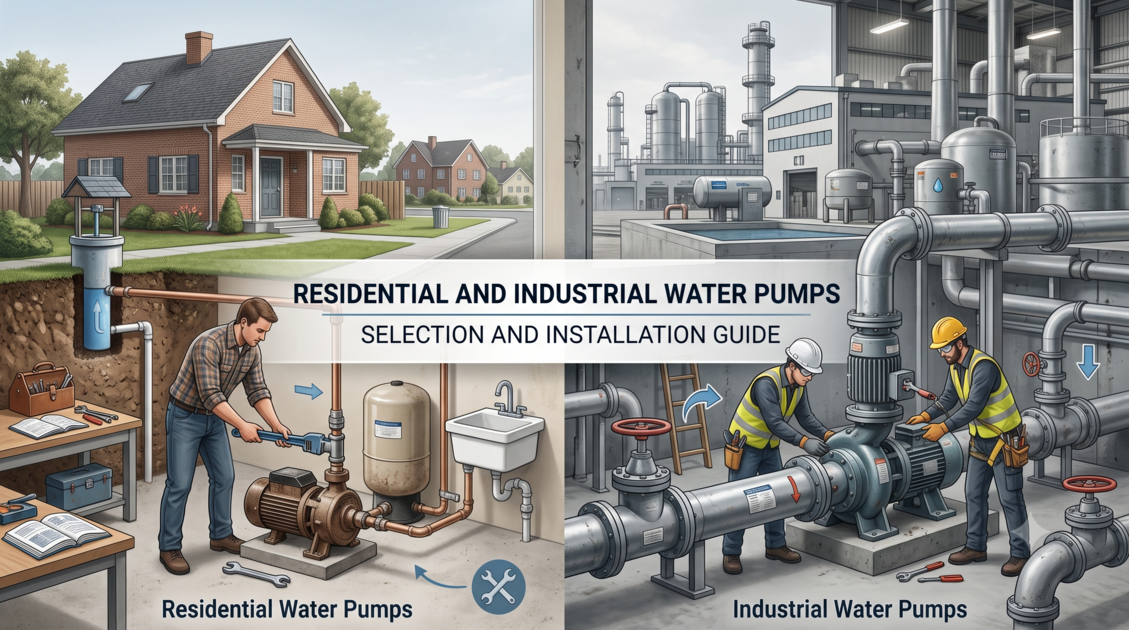
Before purchasing, it is essential to understand the different types of pumps and their primary uses:
1. Surface Pumps
These pumps are installed above ground level and draw water from a nearby source such as a ground-level tank or water pond. They are easy to install and maintain and are widely used in Jordanian homes to lift water from the ground tank to the rooftop tank.
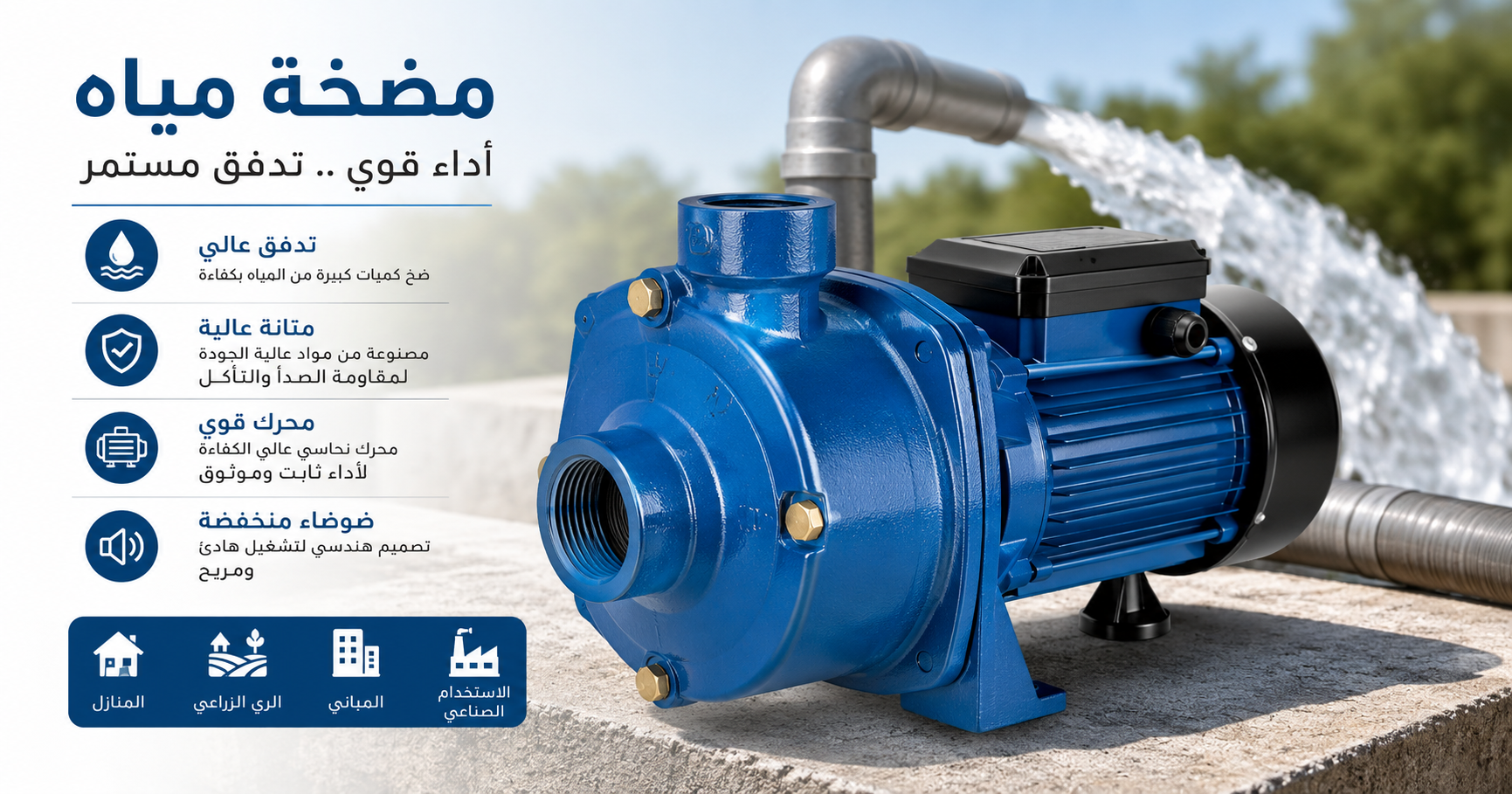
- Centrifugal Pump: The most common type for domestic use, operating on the centrifugal force principle to push water. Suitable for lifting water to heights of 40-50 meters.
- Booster Pump: Used to increase water pressure in the home plumbing network when pressure is weak, especially on upper floors.
- Self-Priming Pump: Capable of drawing water even when the suction pipe is empty, making it very practical for farm use.
2. Submersible Pumps
These pumps are fully submerged in water, whether in an artesian well or a deep tank. They are capable of lifting water from great depths exceeding 200 meters.
- Deep Well Pump: Specifically designed for artesian wells at depths ranging from 30 to 250 meters. Commonly used on Jordanian farms, particularly in the Jordan Valley and Mafraq region.
- Tank Submersible Pump: Smaller in size and used inside ground-level water tanks to lift water to the rooftop tank.
- Drainage Pump: Designed for draining accumulated water in basements and pits, capable of handling solid impurities in the water.
3. Peripheral Pumps
Also known as vortex pumps, these are economical and provide high pressure with relatively low flow. Suitable for simple domestic uses and small garden irrigation. Their capacity typically ranges from 0.5 to 1 HP.
4. High-Pressure Pumps
Used in applications requiring very high pressure, such as sprinkler irrigation systems on large farms or fire suppression systems. They feature high power ranging from 3 to 10 HP.
Technical Specifications You Must Understand Before Buying
To choose the right pump, you need to understand these essential specifications:
Flow Rate
Measured in liters per minute (L/min) or cubic meters per hour (m3/h). This determines the amount of water the pump delivers per unit of time.
- For regular home use: 30-60 L/min
- For small garden irrigation: 50-100 L/min
- For medium farms: 100-300 L/min
- For large farms: 300+ L/min
Head (Lift Height)
Measured in meters, this determines the maximum height to which the pump can lift water. It includes:
- Suction Head: The vertical distance from the water source to the pump. Usually does not exceed 7-8 meters for surface pumps.
- Delivery Head: The vertical distance from the pump to the delivery point.
- Total Head: The sum of suction and delivery head plus friction loss in pipes.
Power Rating
Measured in horsepower (HP) or watts (W). General guidelines:
- 0.5 HP (370W): Suitable for lifting water from a ground tank for a two-story house
- 1 HP (750W): Suitable for a 3-4 story house or small garden
- 1.5 HP (1100W): Suitable for a small farm or drip irrigation
- 2-3 HP (1500-2200W): Suitable for medium and large farms
- 5+ HP: For deep wells and large farms
Pipe Diameter
The pump's inlet and outlet diameter must match the existing pipe network. Common diameters are 1 inch, 1.25 inches, 1.5 inches, and 2 inches. Choosing a diameter smaller than needed reduces flow and increases stress on the pump.
How to Choose the Right Pump for Your Home
Follow these steps to determine the ideal pump for your home use:
Step 1: Define the Purpose
- Lifting water from ground tank to rooftop tank: You need a surface pump or small submersible pump
- Boosting water pressure in the network: You need a booster pump
- Garden irrigation: You need a centrifugal or peripheral pump
- Draining rainwater or sewage: You need a submersible drainage pump
Step 2: Calculate the Required Head
Measure the vertical distance from the water source to the highest point you want to deliver water to. Add 20-30% as a reserve to compensate for pressure loss in pipes and fittings. Example: if the height is 15 meters, choose a pump with a head of at least 20 meters.
Step 3: Estimate the Required Flow Rate
For a typical Jordanian household (3-4 people), a flow rate of 30-50 L/min is sufficient. If you have a garden that needs irrigation, add 20-30 L/min extra.
Step 4: Check Your Power Source
Most domestic pumps run on single-phase 220V power, which is available in all Jordanian homes. Larger pumps (over 3 HP) may require three-phase 380V power.
How to Choose the Right Pump for Your Farm
Choosing a farm pump is more complex and requires precise calculations:
Determining the Water Source
- Artesian well: You need a submersible pump with capacity matching the well depth and static/dynamic water levels
- Surface tank or pond: You need a surface centrifugal pump
- River or irrigation canal: You need a self-priming pump resistant to impurities
Calculating Irrigation Needs
The calculation depends on several factors:
- Farm area in dunums
- Type of crops grown (vegetables need more irrigation than fruit trees)
- Irrigation system used (drip, sprinkler, or flood)
- Soil type and local climate
As a rough guideline: one dunum requires 3-5 cubic meters per day using drip irrigation in Jordan's hot climate. For a 10-dunum farm, you will need a pump with a minimum flow of 5-8 cubic meters per hour.
Special Considerations for Farms in Jordan
- Jordan Valley: Very hot climate in summer; pumps with heat-resistant motors are needed. Wells are typically 50-150 meters deep.
- Highlands (Amman, Irbid, Karak): Well depths are greater (100-300 meters), requiring high-capacity submersible pumps.
- Desert and Badia regions: Limited water sources necessitate high-efficiency pumps to minimize waste.
Best Water Pump Brands at ESCO
ESCO offers a wide range of water pumps from leading global brands:
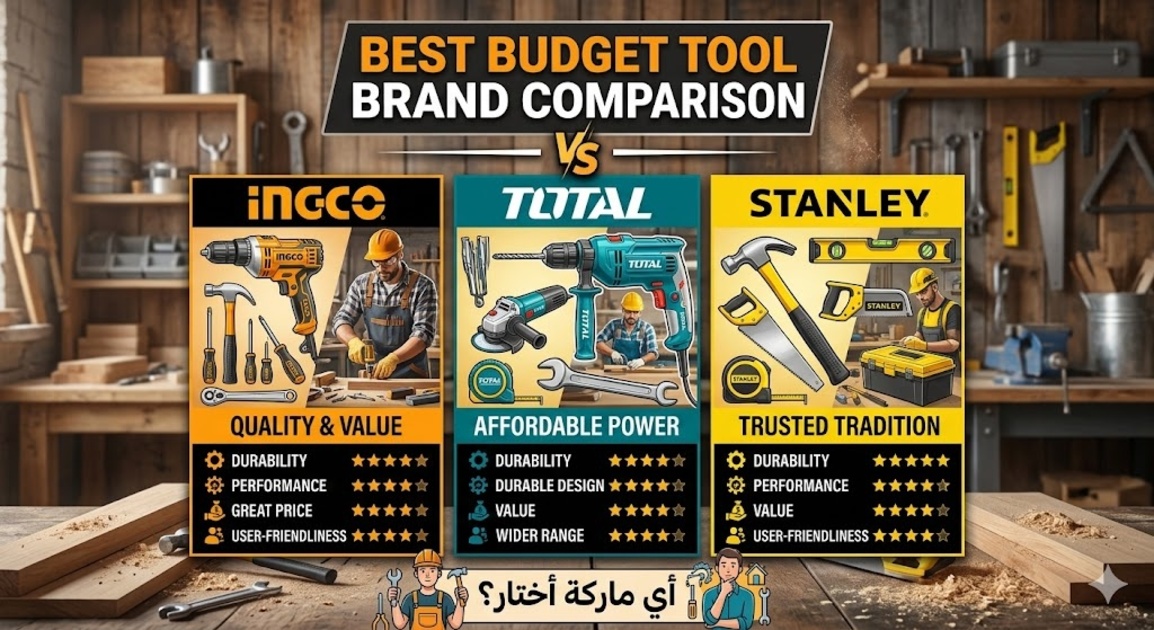
INGCO - The Outstanding Economical Choice
INGCO provides a complete range of water pumps at very competitive prices with reliable quality. Their pumps are known for durability and stable performance:
- Surface Pumps: With capacities from 0.5 to 1.5 HP, ideal for home use. Prices start from approximately 35 JOD.
- Submersible Pumps: Suitable for medium-depth wells, with capacities up to 2 HP.
- Drainage Pumps: For efficiently draining water from basements and pits.
TOTAL - The Balance Between Price and Performance
TOTAL offers a diverse product line of pumps covering most domestic and agricultural needs:
- Centrifugal Pumps: With flow rates up to 200 L/min
- Automatic Pressure Pumps: Operate automatically when a faucet is opened and stop when closed
- Submersible Pumps for clean and dirty water: Prices start from 40 JOD
Bosch - German Quality
Bosch pumps are distinguished by high energy efficiency and long service life. Ideal for those seeking a long-term solution:
- Garden pumps with compact design and excellent performance
- High-pressure pumps for irrigation and cleaning
- Energy efficiency up to 30% higher than competitors
Makita - Power and Durability
Makita is renowned for its powerful motors and pumps designed for heavy-duty use:
- Portable gasoline pumps ideal for farms far from power sources
- Industrial submersible pumps for heavy-duty applications
- Comprehensive warranty and technical support available in Jordan
FINDER - A Reliable Choice for Farms
FINDER offers water pumps with excellent specifications and competitive prices, especially in the deep well submersible pump category. ESCO provides a wide range of FINDER products with warranty and spare parts.
Important Tips Before Buying a Water Pump
1. Do Not Buy a Pump Bigger Than You Need
A bigger pump is not necessarily better. The right pump is one that operates at 70-80% of its maximum capacity. An oversized pump consumes more electricity and faces issues from running without sufficient load.
2. Choose the Right Material
- Cast Iron: Durable and withstands high pressure, suitable for farms and heavy-duty use
- Stainless Steel: Resistant to rust and corrosion, ideal for water with high salt content (common in Jordan)
- Reinforced Plastic: Lightweight and economical, suitable for light domestic use
3. Verify Warranty and Spare Parts Availability
Always buy from an authorized dealer like ESCO to ensure a genuine warranty and spare parts availability. Pumps from unreliable sources may save you a few dinars but will cost more when maintenance is needed.
4. Consider a Pump with Automatic Control
Pumps equipped with an automatic pressure switch or electric float save effort and protect the pump from dry running. The cost of an automatic system ranges from 10-30 JOD extra but is a worthwhile investment.
5. Consult a Specialist
If your use is for a farm or deep well, do not hesitate to consult ESCO's specialized technicians. They can help you calculate exact requirements and choose the ideal pump for your situation.
Water Pump Installation: Essential Tips
For Surface Pumps
- Place the pump on a level, sturdy base to reduce vibrations
- Ensure all connections are tight to prevent air leaks in the suction pipe
- Install a check valve on the suction pipe to prevent water loss when the pump stops
- Do not exceed a suction height of 7 meters to ensure optimal performance
- Fill the pump and suction pipe with water before the first run (priming process)
For Submersible Pumps
- Ensure the pump diameter is suitable for the well diameter (leave at least 2 cm clearance on each side)
- Never run the pump outside water, even for testing
- Use a waterproof electrical cable with the appropriate cross-section for the cable length
- Install a control panel that includes dry-run and overcurrent protection
- Secure the pump with a stainless steel cable, not just the pipe
Important Safety Warnings
- Warning: Never operate any electric pump without proper electrical grounding. The risk of electric shock is real and potentially fatal.
- Warning: Never run the pump without water (dry running) even for a few seconds. This will damage the mechanical seals and put the pump out of service.
- Warning: On farms, ensure electrical wiring is away from water sources and protected by a Ground Fault Circuit Interrupter (GFCI).
- Warning: Do not use a clean water pump to pump water containing sand or gravel. Use a pump designed for dirty water.
- Always disconnect power completely before any maintenance or repair work on the pump.
Water Pump Maintenance and Extending Its Life
Regular maintenance significantly extends the pump's lifespan and maintains its efficiency:
Monthly Maintenance
- Check for leaks in connections and pipes
- Listen for any abnormal sounds during operation (rattling or grinding)
- Ensure the pump is not vibrating excessively
- Clean the suction filter if present
Annual Maintenance
- Inspect mechanical seals and replace when needed
- Check the condition of the impeller and pump casing
- Measure the electrical current draw and compare with original specifications (increased current indicates a problem)
- Inspect the check valve and replace if it is not functioning properly
- In areas with hard water, remove calcium deposits from inside the pump
Water Pump Price Comparison in Jordan (2026)
Prices vary by type, capacity, and brand. Here is an approximate price guide:
- Surface pump 0.5 HP: 30-60 JOD
- Surface pump 1 HP: 50-100 JOD
- Automatic booster pump: 60-150 JOD
- Submersible tank pump: 40-90 JOD
- Well submersible pump (1-2 HP): 150-350 JOD
- Deep well submersible pump (3-5 HP): 300-700 JOD
- Submersible drainage pump: 35-120 JOD
ESCO offers competitive prices on all types of pumps with official warranty and after-sales service. It is recommended to visit the nearest branch or the website esco.jo to check the latest offers and prices.
Conclusion: How to Make the Right Decision
Choosing the right water pump is not complicated if you follow the correct steps. Start by defining the purpose, then calculate the required head and flow rate, and choose the brand that fits your budget. Remember that investing in a high-quality pump from ESCO will save you maintenance and replacement costs in the long run.
Whether you are looking for a simple pump for your home or a complete pumping system for your farm, the specialized team at ESCO is ready to help you make the best decision. Do not hesitate to visit any of our branches throughout the Kingdom or contact us through our website for a free consultation.