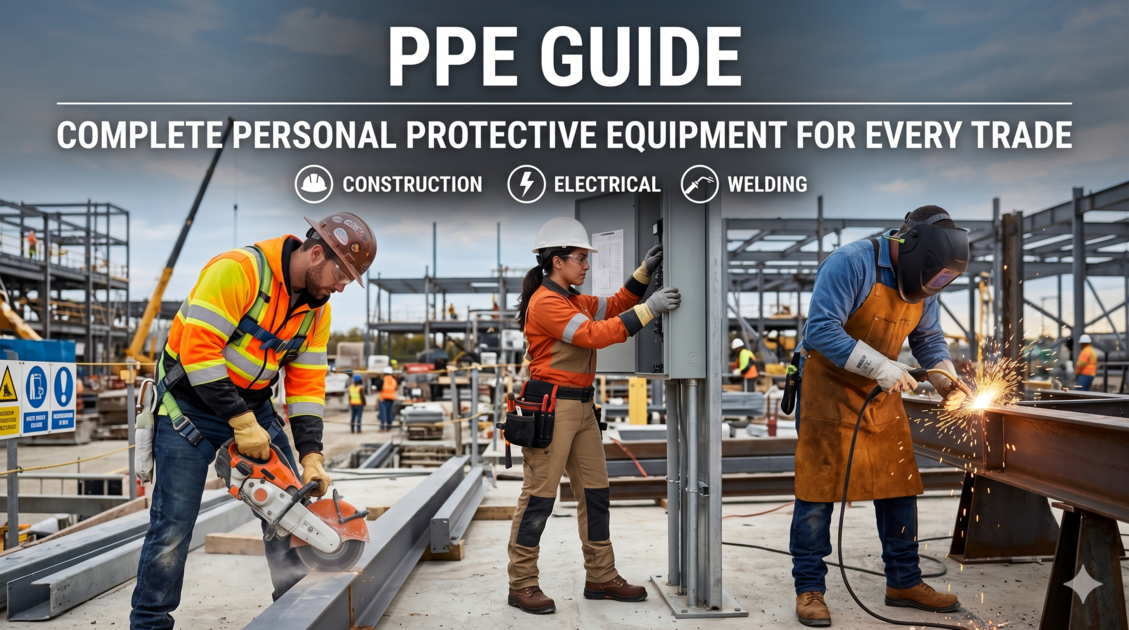
PPE Guide: Complete Personal Protective Equipment for Every Trade
Introduction: Why PPE Is Not Optional but Essential
Every year in Jordan, thousands of workplace injuries are recorded — most of which could have been prevented with proper personal protective equipment. Whether you are a construction worker on major Amman projects, a welding technician in the Sahab industrial zone, or even a hobbyist working in your home workshop, Personal Protective Equipment (PPE) is the last line of defense between you and injury.
In this comprehensive guide from ESCO, Jordan's largest industrial tools and hardware store, we cover everything you need to know about PPE: from types and standards, to choosing the right equipment for your trade, with practical recommendations on the best products available in the Jordanian market.
What Is Personal Protective Equipment (PPE)?
Personal protective equipment refers to any device or garment designed to protect a worker from health and physical hazards in the work environment. PPE covers protection for the head, eyes, ears, respiratory system, hands, feet, and the entire body. According to international safety standards such as OSHA (Occupational Safety and Health Administration) and EN (European Standards), employers must provide appropriate protective equipment to all workers at no cost to them.
PPE is divided into several main categories based on the body part being protected, and each category has specific standards and specifications that must be followed to ensure effective protection.
Head Protection: Safety Helmets
Types of Safety Helmets and Their Standards
The safety helmet is the most important piece of protection on construction and building sites. Helmets are classified according to the European standard EN 397 into several categories:
- Type I: Protects the top of the head from vertical impacts only — the most common type on construction sites.
- Type II: Provides comprehensive head protection from the top and sides, suitable for work in confined spaces and tunnels.
Helmets are also classified electrically:
- Class E (Electrical): Withstands voltage up to 20,000 volts — ideal for electrical technicians.
- Class G (General): Withstands voltage up to 2,200 volts — suitable for general use.
- Class C (Conductive): Provides no electrical protection — used only where there is no electrical hazard.
Tips for Choosing a Safety Helmet
When choosing a safety helmet, pay attention to the following points:
- Internal suspension system: Choose a helmet with a 4-point or 6-point suspension system for better impact distribution. TOTAL helmets available at ESCO feature a 6-point system with an adjustable chin strap.
- Ventilation: In Jordan's hot summer weather (temperatures reaching 40 degrees Celsius), choose a helmet with ventilation openings. However, avoid ventilated helmets if you work near electrical sources.
- Weight: Lightweight helmets (250-350 grams) reduce neck fatigue during long working hours.
- Service life: Replace the helmet every 3-5 years from the date of manufacture, or immediately after any strong impact even if it appears intact.
Safety helmet prices at ESCO range from 2.5 JOD for basic helmets from TOTAL and INGCO, up to 15 JOD for advanced helmets with integrated face shields and hearing protection.
Eye and Face Protection
Safety Glasses
Safety glasses protect the eyes from flying debris, dust, and ultraviolet rays. They must carry the EN 166 or ANSI Z87.1 mark. When choosing safety glasses:
- For cutting and grinding: Choose glasses with impact-resistant polycarbonate lenses and side protection. INGCO HSG04 safety glasses provide excellent protection at an economical price (approximately 1.5 JOD).
- For welding: Use auto-darkening welding helmets with a shade level of DIN 9-13. TOTAL welding helmets are available at ESCO starting from 12 JOD.
- For chemical work: Use sealed goggles that prevent liquid and vapor ingress.
Face Shields
Face shields provide complete facial protection from splashes and large debris. They are used with safety glasses, not as a replacement. FINDER face shields available at ESCO are lightweight and can be flipped up when not needed.
Hearing Protection
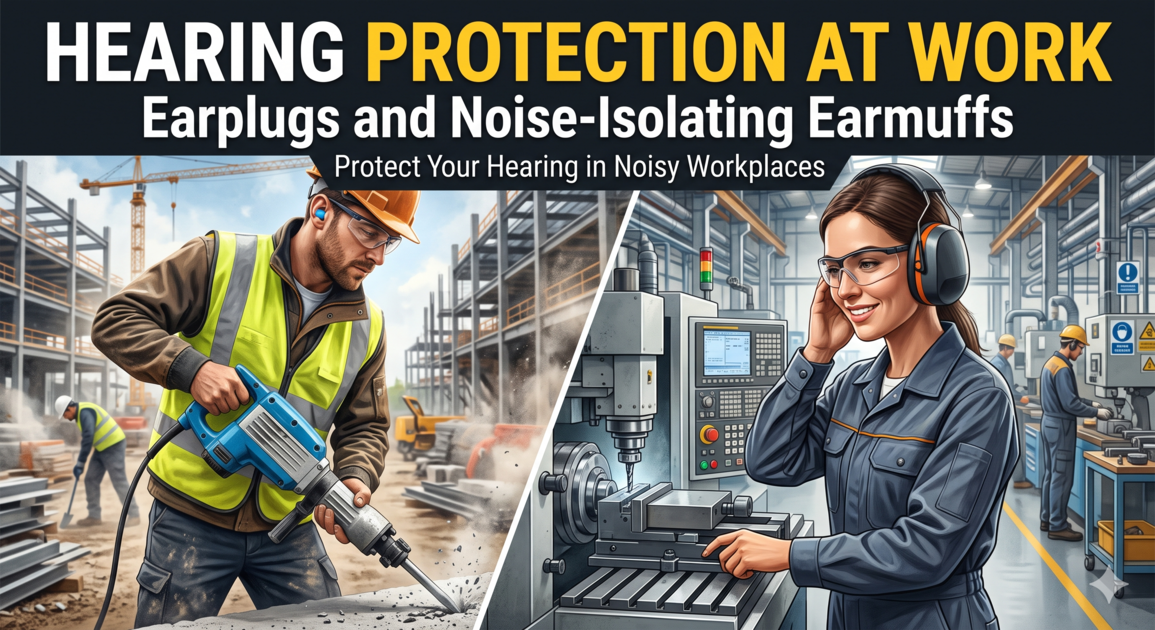
Continuous exposure to noise exceeding 85 decibels causes permanent hearing damage. For comparison, an electric drill produces about 95 decibels, and a circular saw reaches up to 110 decibels. Two main hearing protection options are available:
- Ear Plugs: Inserted into the ear canal, reducing noise by 20-30 decibels. Suitable for extended use and economical (a box of 200 pieces for about 5 JOD from ESCO).
- Ear Muffs: Cover the entire ear, reducing noise by 25-35 decibels. More comfortable for short-term use and easy to put on and take off. TOTAL TSP701 ear muffs feature soft cushions and an adjustable headband.
Important tip: In extremely noisy environments (over 100 decibels), use ear plugs and ear muffs together for maximum protection.
Respiratory Protection
Types of Respirator Masks
Choosing the right respirator depends on the type of hazard:
- Dust masks (FFP1): Filter 80% of particles — suitable for light work such as carpentry and cleaning.
- FFP2 masks: Filter 94% of particles — suitable for grinding, sanding, and working with fiberglass.
- FFP3 masks: Filter 99% of particles — essential for working with toxic materials like asbestos and lead.
- Half-face masks with replaceable filters: Economical in the long run, allowing filter replacement based on the type of hazard (dust, organic vapors, acid gases).
At ESCO, respirator masks from TOTAL and INGCO are available at prices starting from 0.5 JOD for disposable paper masks up to 8 JOD for rubber half-face masks with dual filters.
Tips for Using Respirator Masks
- Ensure the mask fits snugly around the nose and mouth — test this by placing your hands on the mask and exhaling forcefully; if you feel air leaking from the sides, readjust.
- Do not use dust masks in environments containing gases or chemical vapors — they provide no protection against these hazards.
- Replace disposable masks after each use, and replace rubber mask filters according to the manufacturer's instructions or when you notice difficulty breathing.
- Shave facial hair before wearing the mask — hair prevents a complete seal and reduces protection effectiveness by up to 50%.
Hand Protection: Gloves
Types of Gloves by Use
Hands are the most injury-prone body parts in the work environment. Choosing the right glove is critically important:
- Leather Gloves: Ideal for general construction work and handling rough and metallic materials. TOTAL TSP14101 gloves are made from durable cowhide and provide excellent protection against scratches and cuts.
- Cut-Resistant Gloves: Made from high-performance fibers such as Kevlar or HPPE. Rated from Level A1 (light protection) to A9 (maximum protection). For working with metal sheets and glass, choose at least Level A4.
- Nitrile Gloves: Resistant to chemicals, oils, and solvents. Suitable for auto technicians and painters. INGCO nitrile gloves are available in boxes of 100 pieces for about 4 JOD.
- Welding Gloves: Made from heat-resistant leather with insulating lining and long cuffs to protect the forearm. They can withstand temperatures up to 250 degrees Celsius.
- Electrically Insulating Gloves: Made from natural rubber, classified by voltage (Class 00 up to 500 volts, Class 4 up to 36,000 volts). Must be visually inspected before each use to check for holes or cracks.
Glove Selection Guide by Trade
Here is a quick guide for choosing the right glove:
- Carpenter: Leather gloves with cut protection (Level A2-A4).
- Electrician: Electrically insulating gloves of the appropriate class + leather gloves over them for mechanical protection.
- Welder: Long leather welding gloves resistant to heat and sparks.
- Plumber: Nitrile or PVC gloves resistant to chemicals and moisture.
- Construction worker: General leather gloves or rubber-coated gloves for better grip.
Foot Protection: Safety Boots
Safety Boot Standards
Safety boots protect feet from falling objects, punctures, slips, and electrical hazards. The European standard EN ISO 20345 classifies boots into several categories:
- SB: Minimum requirement — steel toe cap withstanding 200 joules.
- S1: SB + oil-resistant sole, energy-absorbing heel area + closed back.
- S1P: S1 + puncture-resistant sole — the most popular choice on Jordanian construction sites.
- S2: S1 + water penetration resistance.
- S3: S2 + puncture-resistant sole — the optimal choice for construction sites and major projects.
Tips for Choosing Safety Boots
- Steel toe vs. composite toe: Steel toe caps are stronger and cheaper, but composite toe caps are lighter, do not conduct cold or heat, and do not trigger metal detectors.
- Comfort: Look for boots with a padded insole and arch support. You will be wearing them 8-10 hours daily, so comfort is not a luxury.
- Slip resistance: Ensure the boot has an SRA, SRB, or SRC slip rating, especially if you work on wet or oily surfaces.
- Proper sizing: Try boots at the end of the day when your feet are at their largest, and wear your work socks during fitting.
At ESCO, safety boots from INGCO and TOTAL are available at prices starting from 12 JOD for basic S1P boots up to 35 JOD for full-height S3 boots. All meet EN ISO 20345 standards.
Body Protection: Workwear and Vests
General Workwear
Good workwear provides both protection and comfort:
- Coveralls: Protect the entire body from dirt, grease, and light chemicals. Choose 100% cotton coveralls for better comfort in Jordan's heat, or cotton/polyester blend (65/35) for higher durability.
- High-Visibility Reflective Vests: Essential for road work and construction sites with vehicle traffic. Must carry an EN ISO 20471 Class 2 rating at minimum. TOTAL reflective vests are available at ESCO starting from 2 JOD.
- Flame-Resistant Clothing: Essential for welders and workers near high-heat sources. Made from special fibers that do not ignite or melt when exposed to sparks.
Fall Protection Harnesses and Systems
When working at heights exceeding 1.8 meters, a fall protection system must be used, including:
- Full Body Harness: Distributes fall forces across the shoulders, thighs, and chest.
- Lanyard with Shock Absorber: Absorbs fall energy and reduces the force transmitted to the body to less than 6 kilonewtons.
- Anchor Point: Must withstand at least 22 kilonewtons.
Fall protection systems from TOTAL and INGCO are available at ESCO with prices starting from 18 JOD for a basic full body harness.
PPE by Trade: Quick Reference Guide
Construction Worker
- Class G or E safety helmet
- Impact-resistant safety glasses
- Ear plugs or ear muffs
- FFP2 dust mask
- Leather or rubber-coated gloves
- S1P or S3 safety boots
- High-visibility vest
- Fall protection harness when working at height
Electrical Technician
- Class E safety helmet (electrical insulation)
- Clear-lens safety glasses
- Electrically insulating gloves of the appropriate class
- EH-rated electrically insulating safety boots
- Flame-resistant clothing (when working near electrical panels)
- Insulated tools rated at 1000 volts
Welder
- Auto-darkening welding helmet
- Respirator with welding fume filter
- Long leather welding gloves
- Leather apron to protect chest and abdomen
- Steel toe safety boots
- Thick cotton or flame-resistant clothing
- Ear muffs for hearing protection
Carpenter
- Impact-resistant safety glasses for debris and sawdust
- FFP2 dust mask (especially when using saws)
- Ear muffs (saws and sanders are high-noise tools)
- Cut-resistant gloves when handling rough boards
- S1P safety boots
Painter and Plumber
- Half-face respirator with organic vapor filters (for painting)
- Sealed safety goggles
- Chemical-resistant nitrile gloves
- Protective coveralls
- Chemical-resistant safety boots
PPE Maintenance and Storage
Damaged or poorly maintained equipment can be more dangerous than wearing no equipment at all, as it gives a false sense of security. Follow these guidelines:
- Daily inspection: Inspect all equipment before each use. Look for cracks, damage, and missing parts.
- Regular cleaning: Clean equipment according to the manufacturer's instructions. Do not use strong chemical solvents that may weaken the materials.
- Proper storage: Store equipment in a dry place away from direct sunlight, high heat, and chemicals.
- Timely replacement: Every piece of equipment has a service life. Helmets should be replaced every 3-5 years, safety harnesses every 5 years, and boots when the sole wears down or the protective toe cap is damaged.
- No modifications: Never modify or repair protective equipment yourself. Any modification voids the compliance certificate and puts you at risk.
Jordanian PPE Legislation
According to the Jordanian Labor Law and the Workers Protection Regulation No. (43) of 1998, employers are required to provide appropriate personal protective equipment to all workers at no cost. Workers are also obligated to wear the provided equipment and maintain it properly. Violations of these regulations can result in financial penalties and site closure in cases of serious danger.
The Social Security Corporation in Jordan requires compliance with safety standards for approval of workplace injury compensation, making PPE provision a financial interest for employers as well.
Why Buy PPE from ESCO?
When purchasing personal protective equipment, quality and reliability are non-negotiable — your life depends on them. At ESCO, Jordan's largest industrial tools and hardware store, we provide:
- Comprehensive selection: All types of protective equipment from trusted brands such as TOTAL, INGCO, Stanley, and FINDER.
- Quality assurance: All products meet international standards (EN, ANSI, ISO).
- Competitive prices: We offer the best prices in the Jordanian market with special deals for bulk purchases.
- Expert consultation: Our team helps you choose the right equipment for your specific work requirements and safety needs.
- Delivery across Jordan: We deliver your order wherever you are in the Kingdom.
Do not compromise on your safety or the safety of your team. Visit esco.jo or contact us to order the right personal protective equipment for your project. Always remember: prevention is far cheaper than treatment, and PPE is not an additional cost — it is an investment in the most valuable thing you have: your health and your life.